Pulling it forward to check the fit, you notice a steady, manageable weight that makes it feel built rather than flimsy. The CIARRA 8-in-1 Steam Oven (the compact 13QT unit) wears a cool, matte gray skin that’s smooth under your palm, and the door handle gives a slightly springy, reassuring resistance when you lift it.Tap the touch panel and soft chimes answer; the interior light reveals chrome racks that slide out with a muted click. From across the kitchen it reads as a small, purposeful box—visually ample without being flashy—and filling the water tank brings a fast hiss and a faint warmed-plastic note that marks the first use.
How the CIARRA steam oven sits on your countertop and becomes part of everyday cooking

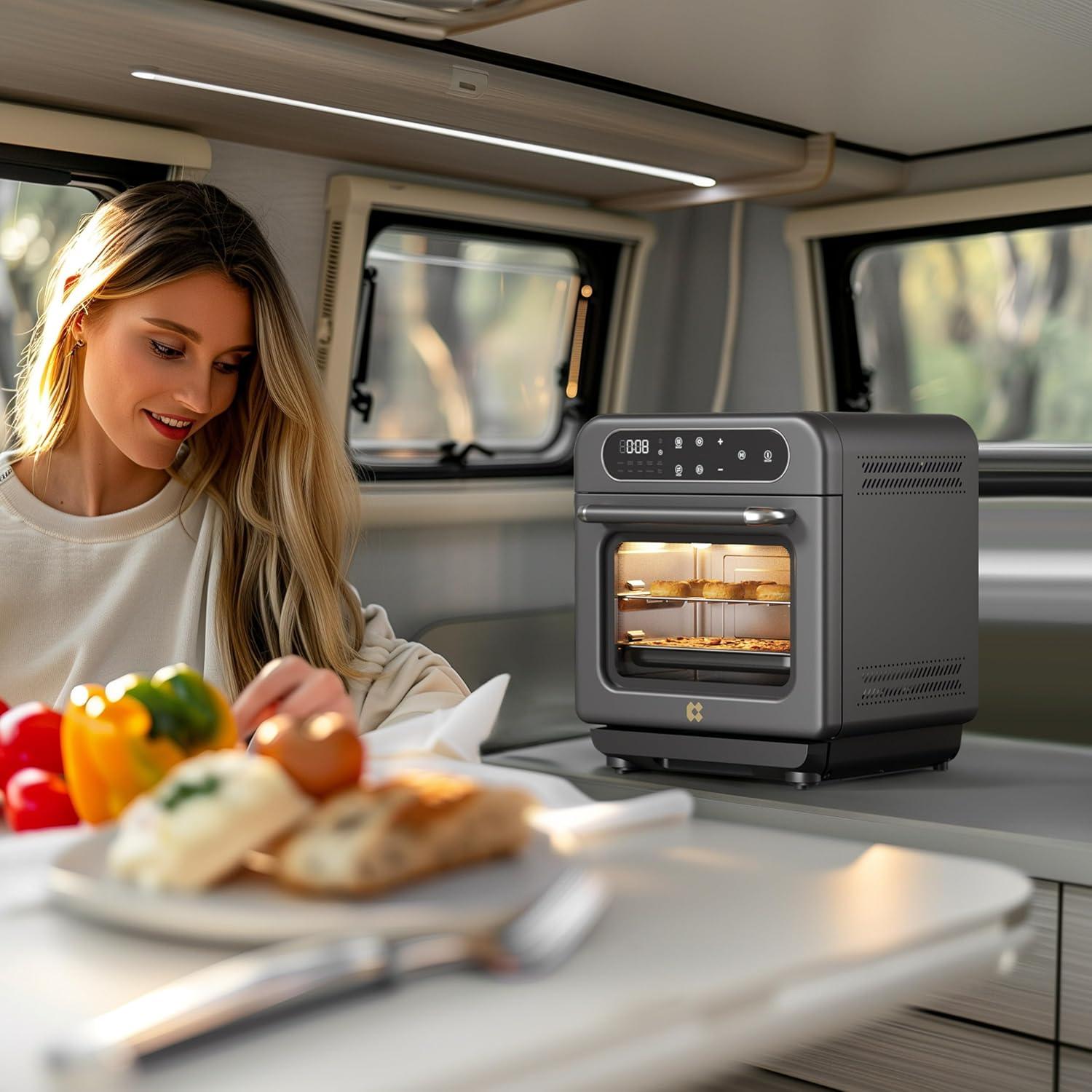
Placed on your countertop, the oven becomes a visible, reached-for tool rather than something hidden away. You’ll find yourself nudging other items — a knife block, a coffee grinder — a little to one side so the door can swing open comfortably; in most kitchens it sits best near an outlet and not too far from the sink, since you occasionally top up the water tank. The controls and handle face you directly, so loading a tray or peeking at progress feels like part of the same motion you use to grab a mug or set down a dish.It has a presence: you notice it every time you clear the counter, and moving it for a deep clean or to make room is something you plan for between meals rather than a daily chore.
Over weeks it folds into routine actions. on a typical morning you reach for it for toast or a quick reheat, then later use it to steam vegetables while you prepare the rest of dinner; sometimes you pause cooking to adjust a rack or refill the water tank, small habits that become automatic. Keep accessories nearby and it changes how you assemble a meal — one tray for veggies, another for a small bake — and the preset options often speed things up without a lot of fiddling.Common daily uses include:
- warming or crisping leftovers
- steaming quick sides while you finish a main
- baking or toasting small items for one or two people
Cleaning and upkeep show up as part of the cadence too: you tend to wipe splatters when they happen and run the self‑clean mode or a quick steam now and then so it’s ready the next time you reach for it.
What you notice when you open it: the materials, weight and the way the door moves
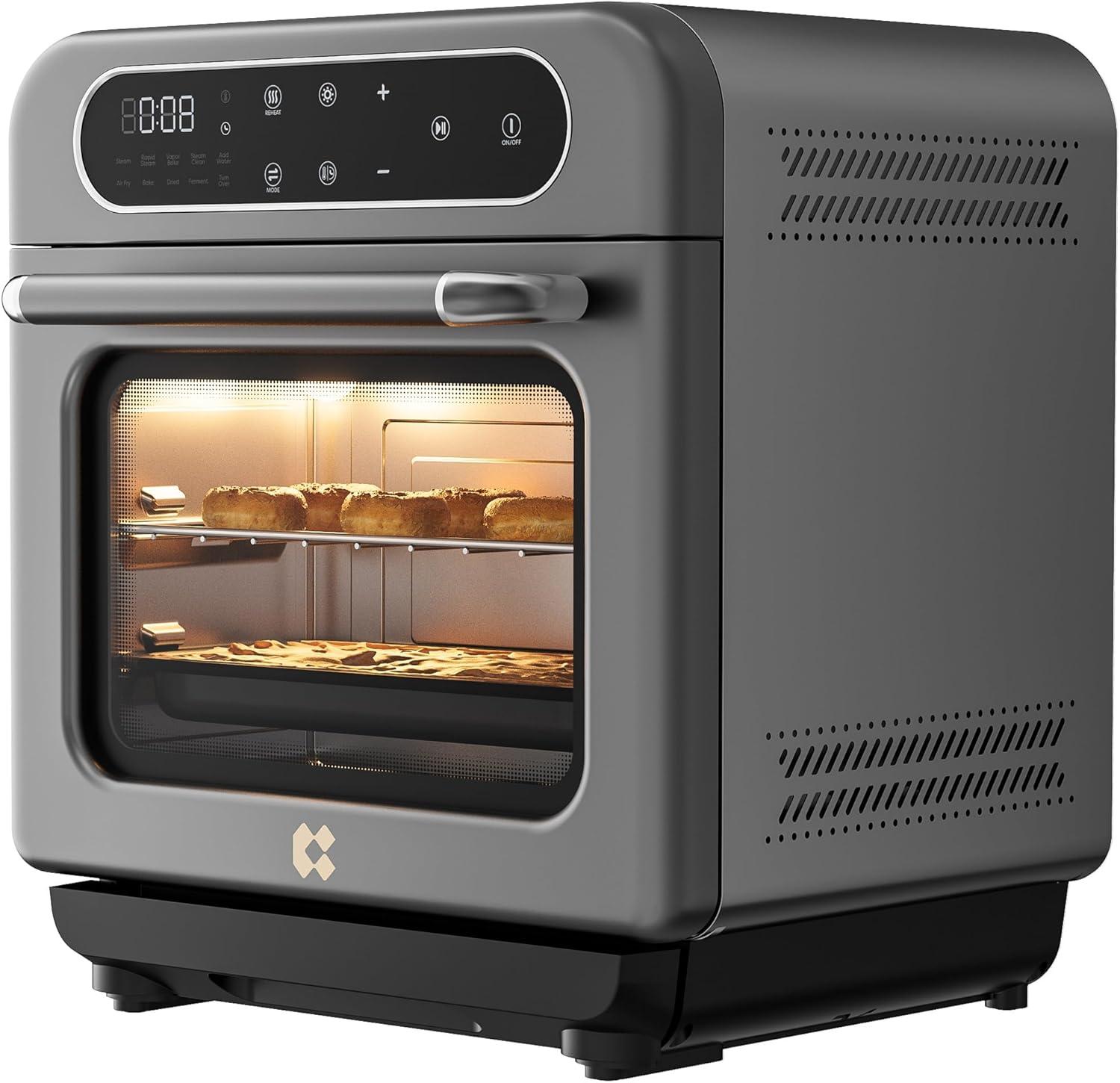
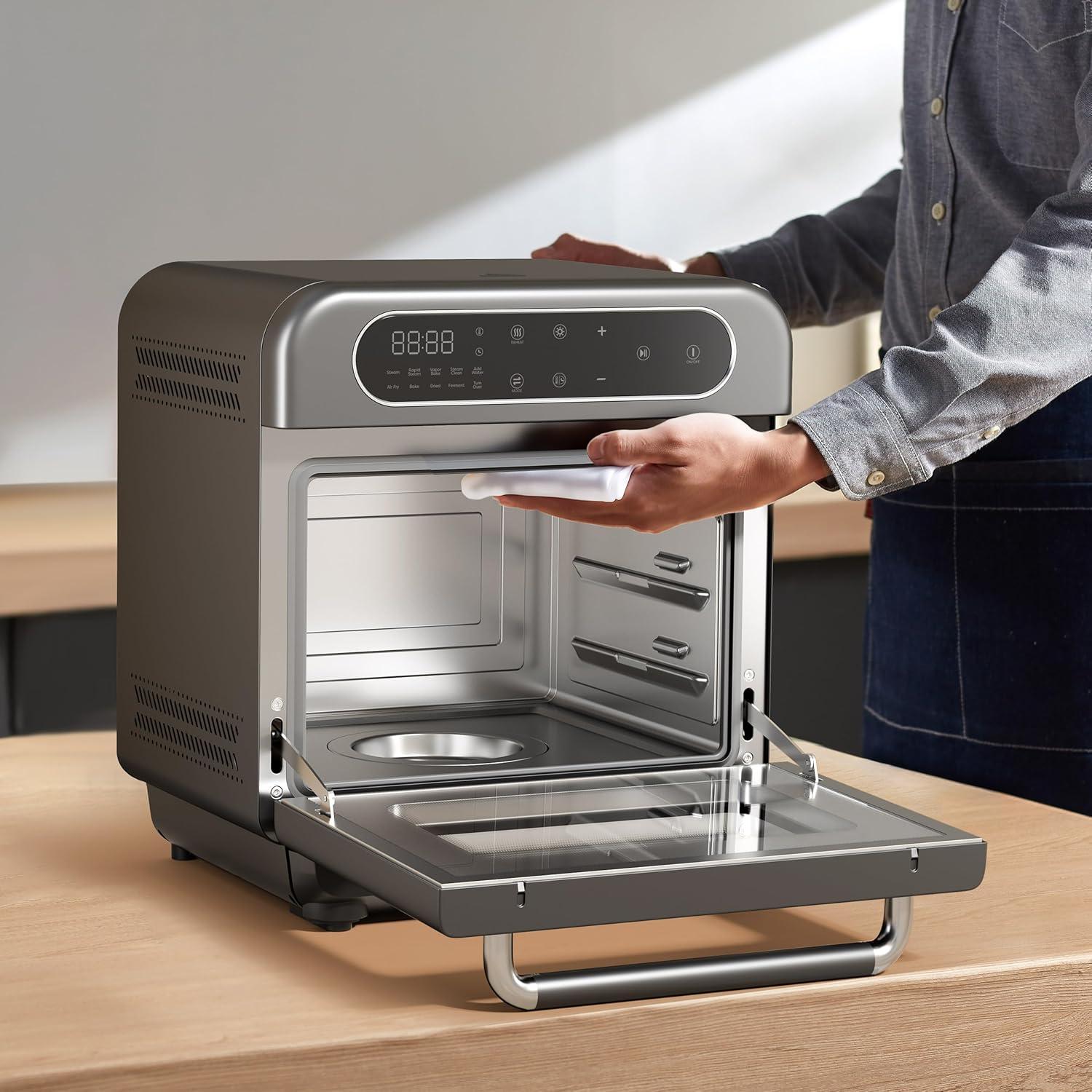
When you swing the door open the first things that register are texture and weight. The face is mostly a smooth, matte-finish metal with a cool-to-the-touch feel, while the door itself presents clear, tempered glass framed by a narrow metal band and a tubular handle that gives a solid grip. Inside, the cavity has a glossy, enamel-like lining and one or two stainless steel racks that slide with a little give; they’re light enough to shift with one hand but have enough heft to feel durable. You’ll also notice a soft, flexible rubber gasket around the opening and a small plastic water-tank access point tucked to one side—each material shows up in routine use, collecting crumbs or a quick wipe now and then.
The door’s motion is measured rather than snappy. It hinges downward on visible metal pivots and descends with steady resistance, so it doesn’t slam shut or spring open; in most cases you can manage it one-handed, though you may pause to steady a heavy tray. Ther’s a slight dampening feel as the hinge reaches the fully open position and the door tends to rest there rather than flop.Small details stand out in use: the handle’s finish hides fingerprints fairly well, the gasket compresses neatly against the frame, and the racks pull in and out without catching.
- Exterior: matte metal-like finish
- Door: tempered glass with metal handle
- Interior: glossy enamel lining and stainless steel racks
- Seal: flexible rubber gasket
| Component | Observed material |
|---|---|
| Outer casing | matte-painted metal-like surface |
| Door/glass | Tempered glass with metal trim |
| Racks | Stainless steel, sliding fit |
| Gasket | Rubber seal around the opening |
Where it finds a home in your kitchen — the scale, clearances and how it fits beside other tools
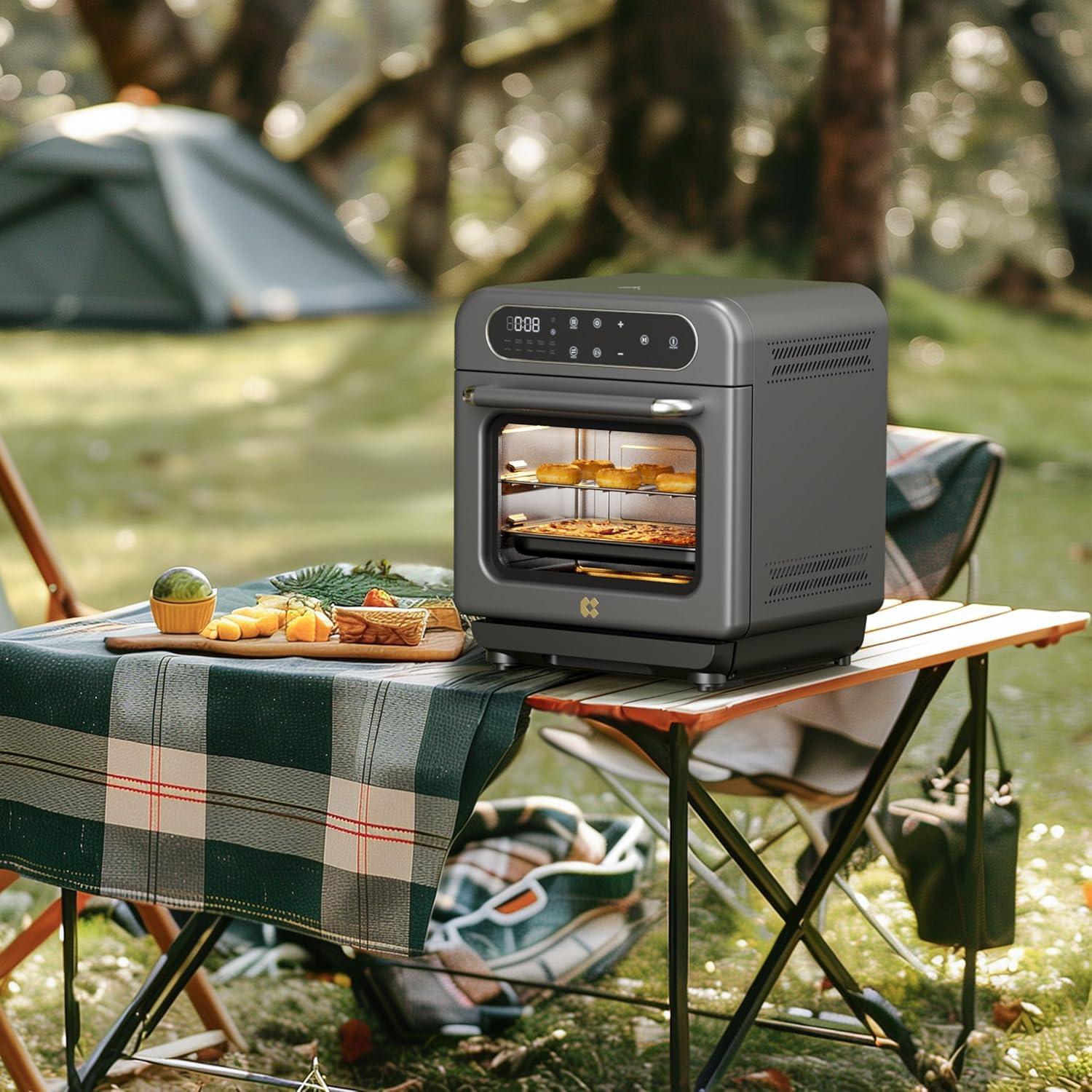
On the counter it takes up a definite, steady footprint: not so small that you can tuck it away every day, but compact enough to sit alongside a kettle or coffee maker without overwhelming the prep area. The front door swings down and the control panel stays at eye level, so you’ll find yourself leaving a clear strip of workspace in front for trays and occasional sliding of the rack; likewise, the back needs a little breathing room for the power cord and the steam outlet, wich tends to direct moisture upward and backward while running. If you keep it under cabinets, the most noticeable trade is vertical clearance when the door is open and a small amount of heat and vapor rising toward the shelf above — enough that you’ll frequently enough shift a lightweight item out of the way before a steam cycle and slide the unit forward to refill the tank or wipe the crumbs away.
In routine use it settles into the same role most countertop appliances do: a semi-permanent station that you approach rather than move constantly. A few habitual interactions become obvious quickly:
- Door swing: plan for an unobstructed downwards sweep and space to pull trays forward.
- Water access: the refill point and removable tank mean you’ll slide the whole appliance out to top up more often than you might at first expect.
- Vent and cord: a little clearance behind prevents steam from fogging nearby surfaces and keeps the plug reachable.
| Area | Observed in-use note |
|---|---|
| Beside a toaster or blender | Fits comfortably with a few inches between units; neighboring appliances may collect light steam residue over time. |
| Under cabinetry | Works if there’s room for the door and rising vapor, otherwise it ends up pulled forward during active use. |
Routine wiping and occasional sliding out for access are part of living with it on the counter rather than hidden away; these small habits shape where it finally rests in your kitchen.
How a week of meals plays out when you use steam, air fry and the preset modes yourself
Across a week you find yourself switching between steam, air fry and the one-touch presets depending on what’s quick and what needs a bit of attention. On weekday mornings you’ll use steam to wake up rice or vegetables — it holds moisture so leftovers reheat without drying out — then lean on air fry for crisping proteins and fries when time is tight. Presets become handy on busy nights: you’ll start a preset roast or bake,check it once or twice and then let it finish. Some evenings you’ll combine modes,using a steam cycle first to gently cook fish or dumplings,then a short air-fry burst to add surface texture; other nights you’ll pick the ferment or dehydrate options for small projects and let them run while you do other things. Little habits creep in: topping up the water tank when you know you’ll steam a few times that day, swapping trays mid-week, or nudging time/temperature a bit when a preset seems to run long for a particular recipe.
Sample week at a glance
- Monday: Steam (vegetables, rice)
- Tuesday: Air fry (chicken wings, reheated pizza)
- Wednesday: Preset Bake (sheet-pan dinner)
- Thursday: Steam‑Bake (fish with steamed sides)
- Friday: Air Fry (fries and quick appetizers)
- saturday: Preset ferment/Dehydrate (small weekend projects)
- Sunday: mix — steam for tenderizing, quick air-fry finish
| Day | Primary Mode |
|---|---|
| Mon–Wed | Steam / Bake for meals that stretch across left‑overs |
| Thu–Fri | Air fry to crisp and finish |
| Sat–Sun | Experiment with presets (ferment, dehydrate, steam‑bake) |
Throughout the week you’ll notice upkeep is part of the rhythm — a quick wipe of splatter after an air-fry night or emptying condensation after a steam-heavy day tends to keep things straightforward — and presets often save time, though you’ll occasionally override them when a recipe needs a tweak.
How the oven meets your expectations and where it reveals limits in real use
In everyday use the oven often delivers on the practical promises that matter during cooking sessions: the steam modes tend to keep baked goods and grains noticeably moister, the timed-steam setting becomes part of the routine for quick sides, and the convection circulation usually produces evenly browned results for single-sheet meals. controls and presets generally make repeated tasks feel straightforward, and the self-clean/steam-clean option reduces the need for heavy scrubbing after greasy batches, even if light wiping is still part of post-cook habit. It heats up noticeably faster than a full-sized oven in most runs, and the unit’s footprint—while present—fits into daily counter rotation, with the water-fill ritual and occasional pausing to check trays becoming small, repeatable motions rather than major interruptions.
That saeid, real-world use highlights a few recurring limits. The air-fry crisping can feel less forceful than a separate fryer, and interrupting cycles (opening the door to shake or check food) frequently enough pauses or resets certain modes, breaking rhythm during busy prep. Mechanical and interface issues have appeared in some sequences of use: gasket displacement can complicate repeated hot cycles over time, touch-screen lag makes mode changes fiddly when timing is tight, and occasional fan noise or an initial manufacturing odor shows up in the first handful of runs. Capacity and accessories also shape behavior—limited racks or trays mean batch cooking is a practical constraint rather than a theoretical one, and the need to refill the water tank becomes an ongoing small task in meal routines.Full specifications and configuration details can be examined hear: Product listing.
What cleaning, steaming and daily upkeep look like once you start living with it
Once it lives on your counter, upkeep becomes a small part of the rhythm of cooking rather than an occasional chore. After most sessions you’ll find yourself wiping the interior surfaces and the glass door to clear condensation and stray crumbs,and emptying the drip/crumb tray so it doesn’t sit damp. Refilling the water tank before a steam cycle is a quick habit for many users, and you may also pause to let the oven cool a little so trapped steam dissipates naturally.Little, frequent actions — a soft cloth over the door, a quick check of the lower tray, an occasional steam-clean run when you notice residue — tend to keep the oven settled into daily use without a big clean-up session every time.
on a weekly or monthly cadence you’ll notice the parts that actually catch the mess need closer attention: racks and pans pick up baked-on bits, edges around the door and the sealing area can collect crumbs, and hard water in your tap may show up as faint mineral streaks inside. In practice that means you slot one longer maintenance moment into your schedule and deal with the few items that accumulate. Typical recurring tasks you’ll see in everyday life include:
- Wiping interior and glass after cooling
- Emptying and drying the crumb/drip tray
- Checking the door seal and the gasket area for trapped debris
- Removing racks/trays for a deeper clean when needed
| Frequency | Common upkeep actions observed |
|---|---|
| Daily / After use | Wipe surfaces, empty drip tray, refill water tank as needed |
| Weekly | Quick wipe of racks and door edges; run a short steam-clean cycle now and then |
| Monthly or as noticed | Deal with mineral streaks or stubborn spots; inspect gasket seating |
How It settles Into Regular use
Over time it becomes a quiet presence on the counter, nudged toward the backsplash when space is tight and reached for without much thought in morning and evening rhythms. The CIARRA 8-in-1 Steam Oven Countertop with Air Fryer, 13QT Mini Convection Toaster Oven with Steam, Rapid steam, Air Fry, Vapor Bake, Steam Clean, Bake, Dried, Ferment, Grey sits among mugs and cutting boards, its finish gathering the small, honest marks of daily use — the occasional fingerprint, a faint water ring at the base, a softening of the plastic where hands habitually rest. In regular household rhythms it is handled more by routine than by attention, moved around the counter, used and then left to cool, its presence a steady, low-key part of the kitchen. After weeks of that unremarked companionship it rests and settles into routine.
As an Amazon Associate I earn from qualifying purchases. Amazon and the Amazon logo are trademarks of Amazon.com, Inc, or its affiliates. All images belong to Amazon